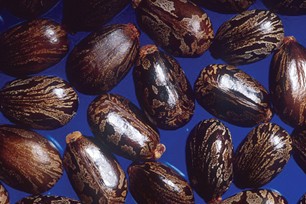
Red bean is the jequirity bean and the brown bean is the castor bean. Both beans contain highly potent toxins. The jequirity bean is the source of abrin and the castor bean is the source of ricin. Both of these toxins are plant proteins known as phytotoxins and share many common properties. Both are composed of 2 peptide chains with the A chain inhibiting protein synthesis and the B chain binds to cell surface receptors.
Ricinus communi (Castor Plant)
Classification
The source of ricin is the castor bean (technically not a bean but a seed). The castor plant classification is:
Kingdom: Plantae
Division: Magnoliophyta
Class: Magnoliopsida
Order: Malpighiales
Family: Euphorbiaceae
Subfamily: Acalyphoideae
Tribe: Acalypheae
Subtribe: Ricininae
Genus: Ricinus
Species: R. communi
Castor plants are native to tropical Africa but are grown commercially to produce castor oil and grown extensively for its bold foliage as a decorative plant in parks and other public areas. The plant may be grown as an annual in colder regions reaching 2-3 meters in height or in warmer climates the height of small trees (12 meters).
Castor seeds have been known for thousands of years and found with ancient Egyptian artifacts. Commercially nearly 1 million pounds of castor oil are produced each year with few accounts of toxicity. The use of castor seed oil in India has been documented since 2000 BC for use in lamps and in local medicine as a laxative, purgative, and cathartic in Unani, Ayurvedic and other ethnomedical systems. Today it is used in the production of synthetic resins, plastics, fibres, paints, varnishes, and various chemicals including lubricants for heavy equipment, drying oils and plasticizers.
Chemistry/Toxicology
The castor seeds contain 20-90% castor oil composed of hydroxy fatty acids. Ricinoleic acid comprises about 90% of the total triglyceride fatty acids of castor oil. Ricin and other proteins in the seeds present the toxicological problem. Ricin has a molecular weight of 60-65 kDa composing 1-5% of the bean. Besides the ricin toxin, there's another compelling reason why this crop has fallen out of favor with U.S. growers. The shiny, beetle-shaped seeds contain powerful allergens. People who work with the off-white meal ground from castor beans may develop allergic reactions, such as hives or asthma. In severe cases, they may go into anaphylactic shock, which can be fatal. Chemistry was first elucidated by Stillmark in 1888 when he noted that the bean extract caused agglutination of red cells. It is now know that this is another protein RCA(ricinus communis agglutinin). Ricin is a potent cytotoxin but only a weak hemagglutinin.
The figure of the ricin structure is a drawing modeled from X-ray crystallography data. The upper right half, the dotted ribbon, is the A chain, and the lower left half, the solid ribbon, is the B chain. The A chain (or RTA)is a 267-amino acid globular protein. It has 8 alpha helices and 8 beta sheets. The substrate binding site is the cleft marked by the substrate adenine ring. The B chain (or RTB) is a 262-amino acid protein that is shaped like a barbell. It has a binding site for galactose at each end, (depicted by lactose rings). These two sites allow hydrogen bonding to specific membrane sugars (galactose and N-acetyl galactosamine). A disulfide bridge (-S-S-) joins RTA with RTB.
The B chain binds to galactose-containing glycoproteins and glycolipids expressed on t the surface of cells. The A chain can then gain access to the cell and inhibits protein synthesis by irreversible inactivating ribosomes through removal of a single adenine residue from RNA loop contained within the 60S subunit. This process prevents chain elongation and leads to cell death. This general mechanism is characteristic of a broad class of toxins such as diphtheria, botulinum and anthrax. The RCA toxin causes agglutination and subsequent hemolysis.
Clinical toxicology cases are from ingestions of the bean and none have been reported from the purified ricin although this was major concern a few years ago. The most famous death was Georgi Markov in London in 1978. Markov was attacked with a specially engineered weapon disguised as an umbrella which implanted a ricin-containing pellet into his body.
Exposure
Most human exposures have occurred from oral ingestion of the seeds. The clinical consequences depended on the concentration of ricin in the seeds and the how well the seeds were chewed. Although death can occur from as little as one seed, ricin does have poor absorption and ingestions of multiple seeds in small children have not been fatal. Ricin injection can be more fatal as evidence by the Markov case. Symptoms even with injection are delayed with nausea and vomiting after 15-24 hours. Death occurred 24-36 hours after injection. Of greater concern from a biological weapons viewpoint is exposure by inhalation. Symptoms again are delayed for 8-24 hours but death occurs from 36-48 hours. The effectiveness of the exposure depends on the particle size of the ricin preparation. The smaller particles reach the small alveoli and are absorbed. It should be noted that sophisticated grinding apparatus is needed to produce the “weapons grade” ricin powders. In experimental animals death (36-48 hrs) from inhalation was due to massive inflammatory response to ricin leading to respiratory insufficiency and death. The LD50 for the inhalation route is 3-5 microgram per kilogram using rodent models as compared to the oral LD50 of 20 mg/kg Additional primate data substantiated an approximate LD50 of 10 microgram per kilogram. Although most workers in castor oil plants are never exposed to ricin many toxic symptoms from other highly antigenic proteins found in the bean.
References
- Lord, J.M., Roberts, L.M., and J.D. Robertus. (1994). FASEB J. Feb; 8(2):201-8.
- Medscape emergency medicine files
- Cornell University Poisonous Plants Informational Database
- CDC Database
- Franz, DR and NK Jaax, "Ricin Toxin" Chapter 32, Medical Aspects of Chemical and Biological Warfare, Office of the Surgeon General, Department of the Army, 1999.
- Audi J, Belson M, Patel M, Schier J, Osterloh J. Ricin poisoning: a comprehensive review. JAMA 2005;294:2342-51.
- Bradberry SM, Dickers KJ, Rice P, Griffiths GD, Vale JA. Ricin poisoning. Toxicol Rev 2003;22:65-70.
- Ler SG, Lee FK, Gopalakrishnakone P. Trends in detection of warfare agents. Detection methods for ricin, staphylococcal enterotoxin B and T-2 toxin. J Chromatogr A 2006;1133:1-12.
- Olsnes S. The history of ricin, abrin and related toxins. Toxicon 2004;44:361-70.
- Hedge, R and S.K. Podder, Studies on the variants of the protein toxins ricin and abrin, Eur. J. Biochem. 1991; 204, 155-164.
- Spivak L, Hendrickson RG. Ricin. Crit Care Clin 2005;21:815-24, viii.
- Patocka, J., "Abrin and Ricin - Dangerous Proteins", ASA 01-4, Issue No. 85, August 31, 2001.
Abrus precatorius (Precatory Bean)
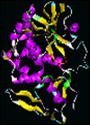
Abrin 3D structure
This is a 1/8" long; bead-shaped bean; red with small black spot at base of seed. The raw seeds contain abrin, a ribosome inactivating protein that is one of the deadliest plant toxins known. Despite their toxicity, the boiled seeds are ingested as a contraceptive and an aphrodisiac (as are the chewed roots). They are also made into a decoction for use as a diuretic, for sore throat, and for rheumatism and the powdered seeds are taken as a snuff for headache. A poultice of the leaves is said to remove freckles and a decoction of the leaves and roots is used for cough, colds, and colic)
Scientific Classification
Scientific Name(s): Abrus precatorius L. Family: Fabaceae (beans)
Kingdom: Plantae – Plants
Subkingdom: Tracheobionta – Vascular plants
Superdivision: Spermatophyta – Seed plants
Division: Magnoliophyta – Flowering plants
Class: Magnoliopsida – Dicotyledons
Subclass: Rosidae
Order: Fabales
Family: Fabaceae – Pea family
Genus: Abrus Adans. – abrus
Species: Abrus precatorius L. – rosarypea
Common Name(s)
Precatory bean, colorine (Mexico), crab's eye (Southeastern U.S.), gunga, gunteh (India -- its native bio-region), jequerite (Colombia), jequirity bean (Canada), lady bug bean, lady bug seed (California), ojo de cangrejo (Panama), peronilla (Colombia), prayer bean (Great Britain), precatory pea, precatory bean (Great Britain, Canada), rosary bean, rosary pea (U.S.), love bean, rosary pea, Buddhist rosary bead, jequirity seed, bead vine, black-eyed Susan, prayer beads, weather plant, lucky bean, abrus a chapelet (France, Quebec) and numerous other locally used common names.
The bean has found widespread use as an art object and ornament. The colorful, hard beans have been used as pendants, rosaries, rattles, necklaces, and in toys such as noise shakers. The bean is used in South American and African folk medicine. For example, in Central and South America charms are available that contain the beans. See the internet site for pictures and references: Central and South American charm vial #2, Peru. The seeds also have been used to treat fever in Chinese medicine. The leaves and roots of the plant have been used in Ayurvedic medicine for treatment of asthma, bronchitis, and other respiratory conditions.
Precatory Bean Uses and Pharmacology
Abrin is a type 2 ribosome inactivating protein. Similar to ricin the toxin is composed of 2 chains (A and B) with distinct functions. The B chain (268 amino acids) binds to galactose units of cell surface carbohydrates. The A chain (251 amino acids) is responsible for the toxic activity. Once inside the cell, the A chain migrates to the 60S unit of the ribosome, acting to inhibit further protein synthesis. Abrin exits in two forms, abrin a and abrin b; both have A and B chains. Abrin has a strong inhibitory effect on protein synthesis, moderate inhibitory effect on DNA synthesis, and little effect on RNA synthesis. Several indole alkaloids (eg, abrin, hyaphorine, precatorine), triterpenoids, and a new glycoside have been also isolated from the plant. Another lectin, abrus agglutinin, which is nontoxic to animal cells and exhibits potent agglutinating activity toward erythrocytes, has been described in Abrus seeds.
Animal Data
Abrin has been used as a molecular probe to investigate cellular function. It has also been evaluated in the treatment of experimental cancers. Although effective when given intraperitoneally (IP) to mice pretreated with L1210 leukemia, no increase in lifespan was noted when the compound was administered IV. In another study in mice, abrin injected IP at a dose of 7.5 mcg/kg every other day for 10 days was effective in reducing solid tumor mass.
Clinical Data
Abrin has been used with some clinical success as an analgesic in terminally ill patients. Ethanolic extracts of the leaves of Abrus possess d-tubocurarine-like neuromuscular blocking activity. Investigations continue on the use of Abrin and Ricin in anti-cancer therapy.
Adverse Reactions
Fatal poisoning in children has been reported after the thorough chewing of as little as half of 1 seed. Because of the irritant effects of abrin on the GI mucosa, ingestion of precatory beans causes severe stomach cramping accompanied by nausea, vomiting, severe diarrhea, cold sweat, and fast pulse. Coma, circulatory collapse, acute renal failure, and hepatotoxicity have also been reported. A recent case of the death a 30-year-old female following the ingestion of 3-4 seeds showed evidence of acute demyelinating encephalitis.
Toxicology
The seeds, roots, and leaves of A. precatorius are all poisonous. The toxin is released when the hard outer covering is pierced, thus allowing absorption into the intestinal secretions, by chewing or drilling holes in the seeds for beadwork, ornaments, or jewelry. Necklaces made of the pierced seeds have been reported to induce dermatitis. Intact seeds remain impervious to gastric fluid and pose less of a toxicologic potential. Some sources list abrin toxicity 75 times that of ricin.
The onset of toxicity usually occurs in 1 to 3 days; symptoms may persist for longer than 10 days. Treatment is supportive and symptomatic. Because of the necrotizing action of abrin, gastric lavage or induced emesis should be used cautiously. Measures to maintain circulation include the correction of hypovolemia and electrolyte disturbances. Alkalinization of the urine to control uremia and enhance toxin excretion has been recommended.
The LD 50 of abrin given IP to mice is 0.04 mcg and 5 mg of the alkaloid abrin is reported to be toxic to humans. In goats, ground seeds administered at a dose of 1 and 2 g/kg/day caused death in 2 to 5 days.
Treatment and Detoxification
Treatments are mostly supportive. Several attempts to develop antibodies to be used as vaccines or protective agents have limited success. None is widely available or approved. Since the major toxins in both Ricin and Abrin are proteins, they can be deactivated by heat and 0.5% hypochlorite solutions. Allergic reactions may occur from deactivated products from ricin or abrin as seen in castor oil production facilities.
References
- A good source of plant information is the University of South Florida
- Fernando C. Poisoning due to Abrus precatorius (jequirity bean). Anaesthesia . 2001;56:1178-1180.
- Cornell University Poisonous Plants Informational Database
- Yadava RN, Reddy VM. A new biologically active flavonol glycoside from the seeds of Abrus precatorius Linn. J Asian Nat Prod Res . 2002;4:103-107.
- Hardin JW, Arena JM. Human Poisoning from Native and Cultivated Plants , 2nd ed. Durham, NC: Duke University Press; 1974.
- Joubert FJ. J Biochem Int . 1983;15:1033.
- Barri ME, el Dirdiri NI, Abu Damir H, Idris OF. Toxicity of Abrus precatorius in Nubian goats. Vet Hum Toxicol . 1990;32:541-545.
- Dickers KJ, Bradberry SM, Rice P, Griffiths GD, Vale JA. Abrin poisoning. Toxicol Rev 2003;22:137-42.
- Ghosh D, Maiti TK. Immunomodulatory and anti-tumor activities of native and heat denatured Abrus agglutinin. Immunobiology 2007;212:589-99.
- Menezes RG, Rao PP, Baliga BS, Arya AD, Jain A, Manipady S. Abrus precatorius poisoning. J Assoc Physicians India 2007;55:458.
- Moshi MJ, Kagashe GA, Mbwambo ZH. Plants used to treat epilepsy by Tanzanian traditional healers. J Ethnopharmacol 2005;97:327-36.
- Ostin A, Bergstrom T, Fredriksson SA, Nilsson C. Solvent-assisted trypsin digestion of ricin for forensic identification by LC-ESI MS/MS. Anal Chem 2007;79:6271-8.
- Pillay VV, Bhagyanathan PV, Krishnaprasad R, Rajesh RR, Vishnupriya N. Poisoning due to white seed variety of Abrus precatorius. J Assoc Physicians India 2005;53:317-9.
- Sahni V, Agarwal SK, Singh NP, Sikdar S. Acute demyelinating encephalitis after jequirity pea ingestion (Abrus precatorius). Clin Toxicol (Phila) 2007;45:77-9.
- Vaidya AD, Raut AA, Vaidya RA. Abrus precatorius, Gaertin--an ayurvedic potent phytomedicine. J Assoc Physicians India 2005;53:739-40.