
By Miranda Chimzar, MD
Published in the September 2025 issue of Clinical & Forensic Toxicology News
History
During late December 1942, in the Romanian concentration camp of Vapniarka, prisoners began falling ill with abnormal gait and brisk reflexes (1). Doctors imprisoned at the camp diagnosed them with spastic paralysis. The symptoms were linked to the food being served to the prisoners when it was noted that the guards remained healthy and the symptoms were not contagious. Thanks to an extensive education campaign, the inmates were alerted to avoid eating the gruel made from grass peas (Lathyrus sativus, Fig. 1), which helped to prevent further morbidity and mortality. It is estimated that 600 to 800 of the 1200 men, women, and children at the camp developed symptoms.
Lathyrism is the general term for symptoms caused by eating certain legumes of the genus Lathyrus (1). Within the genus Lathyrus, there are over 160 species, 20 of which produce the compound Oxalyl-diamino-propionic acid (ODAP), which produces neurologic symptoms in humans and animals (2). These neurologic symptoms of lathyrism are further classified as neurolathyrism and are most commonly associated with the plant Lathyrus sativus. Other tissues, such as bones (osteolathyrism) and vasculature (angiolathyrism), can also be affected (3). Osteolathyrism has primarily been seen in animals and is associated with different species of the plant, Lathyrus odoratus, hirsutism, and pusillus (1).
Lathyrism has been reported as early as 46 BC by Hippocrates and in ancient Hindu writings (3). Hippocrates wrote, “At Ainos, all men and women who ate peas continuously became impotent in the legs and that state persisted.” Hindu texts mention that a certain legume could “cause a man to become lame and crippled and it irritates the nerves.” The symptoms were severe enough to lead the Duke of Würtemberg to forbid the consumption of bread made from the flour of lathyrus peas in 1671. Bans such as these remain in some countries even today (4).
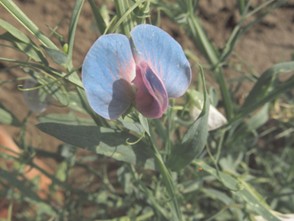
Lathyrus sativus is a drought-tolerant crop that can be grown in sand or clay and is tolerant to pests and disease (4). It is usually made into gruel or ground into flour and provides protein, carbohydrates, iron, zinc, magnesium, folate, and vitamin C. These factors have led to continued interest in using Lathyrus sativus as a food source. Recent studies have suggested that environmental factors such as osmotic stress and heavy metals in the soil lead to high ODAP content, and correcting these conditions may enable the plant to be eaten safely (4). Other agriculturists have seen promise in toxin reduction through breeding with wild relatives (2). Findings like these have led to bans being lifted in recent years (4).
Pharmacology and toxicology
The toxic compound that causes neurolathyrism is ODAP (4). Additional nomenclatures for the compound include beta-N-oxalytlamino-L-alanine and L-3-oxalyl amino-2-amino-propionic acid. ODAP is found in two isomeric forms, a and b , with b -ODAP accounting for 95% of the toxin produced in Lathyrus sativus (2). The excitotoxic amino acid is an analog of L-glutamic acid and acts on the AMPA-type glutamate receptor (a-amino-3- hydroxy-5-methy-4isoxazole propionate) (5). Stimulation of the receptor leads to calcium influx, oxidative stress, and eventually motor neuron damage and cell death (4). With prolonged consumption of Lathyrus sativus, the toxin’s effects build up in the body, leading to symptoms of lathyrism.
The compound responsible for osteolathyrism and angiolathyrism is beta-amino-propionitrile (3). BAPN has not been shown to have any neurolathyritic effects. It is thought that BAPN causes increased connective tissue fragility, leading to weakening of the elastic fibers in arteries and alterations in bone development.
Health and agricultural impacts
Symptoms of lathyrism usually present within months to years of prolonged consumption of the plant (4). Those affected by neurolathyrism demonstrate spastic paralysis predominantly of the lower portion of the body along with pain, cramps, tremors, frequent urination, and impotence (6). Symptoms tend to be especially disruptive at night. A physical examination often shows clonus, muscle rigidity, muscle atrophy, and a positive Babinski’s sign, but largely retained sensation (3). Osteolathyrism may present with fusion of epiphyses and bowing of the femur (1). Young men tend to be affected more than other demographics, but the development of symptoms depends on the amount and duration of consumption, genetics of the plant and consumer, malnutrition such as vitamin B6 deficiency, and growing conditions (4). There is no treatment for lathyrism; those affected receive supportive care for their symptoms (6).
Following the devastation at Camp Vapniarka, neurologists were able to follow a cohort over 30 years to track the effects of chronic lathyrism (1). All the patients followed had spastic paralysis with gait disturbances such as scissoring gait with stiff legs, walking on the balls of their feet, and often requiring canes, crutches, or even wheelchairs for mobility. The gait abnormalities were primarily due to increased tone in the thigh extensors and adductors, and gastrocnemius muscles. Only a few patients had involvement of the upper limbs, and the neurogenic bladder symptoms lessened in the chronic stage of the disease.
As a grain, Lathyrus species have been used to feed livestock. These animals, including cows, sheep, pigs, chickens, and horses, are also susceptible to developing lathyrism, showing muscular weakness of the loins and extremities, paralysis, lack of coordination, thickening of the arterioles and capillaries within the spinal cord, and dissecting aneurysms (3, 4). Different animals show varying degrees of susceptibility (3). Horses are extremely sensitive to toxins and may even die from exposure. Feeding a horse a diet of 20% Lathyrus sativus results in symptoms, while pigs and cattle tolerate higher amounts.
Laboratory testing
ODAP and beta-amino-propionitrile are not common compounds tested for in the laboratory. Lathyrism is a clinical diagnosis made using a thorough physical exam and dietary history. Neurologic imaging and electromyographic studies may be helpful, but are often not specific (6). Histologic studies in humans demonstrate anterolateral sclerosis in the dorsolumbar spinal cord and decreased numbers of Betz’s cells in the primary motor cortex (3). Partial degeneration of the motor tracts of the spinal cord, along with microgliosis in the anterior horn and lateral cords, has been appreciated in animal models.
References
- Garfinkle J, Andermann F, Shevell MI. Neurolathyrism in Vapniarka: medical heroism in a concentration camp. Can J Neurol Sci 2011;3:839-44.
- Singh A, Balech R, Barpete S, Gupta P, Bouhlal O, Tawkaz S, et al.Wild lathyrus – a treasure of novel diversity. Plants 2024;13:3028.
- Barrow MV, Simpson CF,Miller EJ. Lathyrism: a review. Rev Biol 1974;49:101-28.
- Singh V,Mishra Y,Mishra VN. Existence of lathyrus beyond lathyrism. Journal of Preventive, Diagnostic and Treatment Strategies in Medicine 2023;2:208-17.
- Kumar P, Prasad A, Sweta GMF. Neurolathyrism with deep vein thrombosis and bony exostosis: are they new forms of angiolathyrism and osteolathyrism. Cureus 2022;14:e27720.
- Eisen A. Disorders affecting the spinal cord. Up to Date (2025). www.uptodate.com/contents/disorders-affecting-thespinal- cord (Accessed June 12, 2025).
Miranda Chimzar, MD, is a cytopathology fellow in the department of pathology at the University of Utah, ARUP Laboratories in Salt Lake City, Utah.
The author has nothing to disclose.